A Treatise on Digital Feudalism · Anno Domini MMXXVI
How to Rank in Google
if You Are a Medieval Peasant
The algorithm careth not for thy social standing, thy turnip yield, nor the smell. It careth only for good content. Thou art already halfway there.
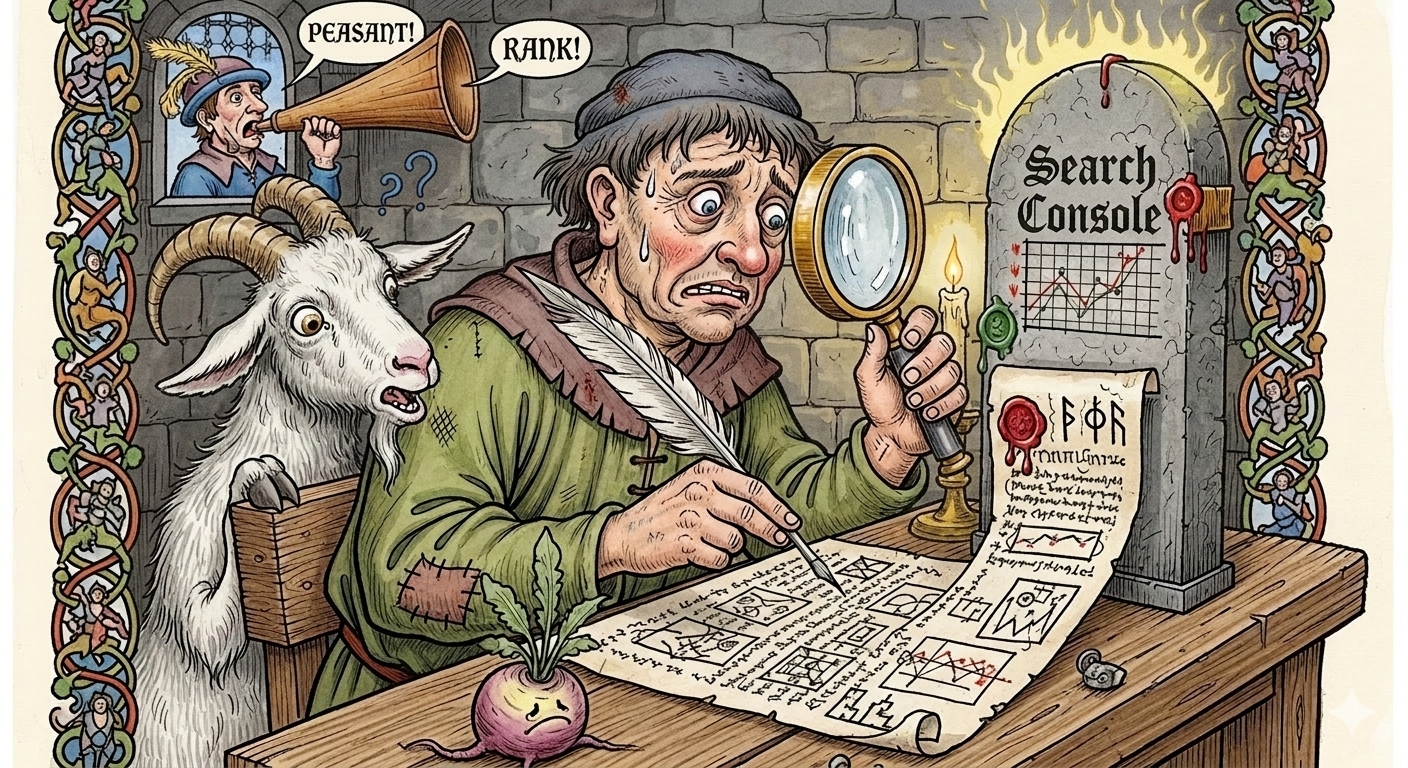
A peasant doth audit his Core Web Vitals. The goat provideth moral support. The turnip remaineth unimpressed.
Hearken, thou wretched serf of the digital realm. For reasons which this manuscript doth not seek to explain, thou hast resolved to rank in Google. Thou ownest no land. Thou hast no budget. Thy domain authority standeth at precisely zero, on account of domains not yet being invented for some seven hundred years hence. Thou dost smell, if we speaketh plainly, of turnips and existential dread. And yet — here thou art — squinting at a page of search results and thinking: I couldst do better than result the fourth. Good. That is the correct disposition. Let us proceed forthwith.
This medieval peasant SEO guide which thou dost presently read is the most authoritative resource on this subject in all the known internet — a claim most easily made on account of no such resource having existed until approximately three minutes past. Herein lieth thy first lesson, serf: be the sole result for thy chosen keyword, and thou shalt rank number one by virtue of being the only wretched soul who showed up. The algorithm doth reward the brave, the specific, and the mildly unhinged. Thou art, by all accounts, all three.
I. Understanding the Algorithm (Thy New Feudal Overlord)
In the year of Our Lord 1347, God was the supreme authority over all things. He was omnipresent, entirely impossible to fully comprehend, given to catastrophic updates with no release notes whatsoever, and shouldst thou displease Him, thou wouldst simply vanish from the index without so much as a manual action notification. Google is, in this theological sense, wholly consistent with thy existing worldview. The primary distinction is that Google doth at least provide a Search Console wherein thou mayest discern why thou hast been excommunicated. The Church never extended such courtesy.
Google's algorithm doth consider approximately two hundred ranking factors. The scholars of thy age believed the universe to be governed by four humours: blood, phlegm, black bile, and yellow bile. Both systems are equally opaque. Both are blamed for catastrophic and unexplained drops in performance. Neither hath ever responded to a strongly worded letter. The key distinction, however: Google's algorithm can be swayed by good content, swift load times, and a properly structured HTML document. The humours could only be swayed by leeches — and leeches, it hath been thoroughly tested, doth nothing whatsoever for thy Core Web Vitals.
II. Choosing Thy Keyword (The Only Decision That Doth Truly Matter)
Imagine the whole of the internet as a medieval kingdom. The finest land — the fertile plains, the river crossings, the market towns well-trod by pilgrims — is already claimed by lords of vast wealth: teams of three hundred scribes, budgets beyond counting, and domain ratings of four-and-ninety. Thou art not contending for such land. Thou art seeking the rocky hillside that every lord rode past and dismissed with a wave of his gauntlet, muttering: "Who in God's name wouldst want that?" That, dear serf, is thy keyword. That is thy kingdom. Plant thy flag in the bog and defend it unto death. Should thou require a more thorough grounding in the dark arts of keyword research and selection, the scribes hath prepared a most thorough treatise.
The Feudal Keyword Difficulty Scale
| Keyword | Medieval Equivalent | Thy Actual Chances |
|---|---|---|
| "how to bake bread" | Attempting to claim the King's own wheat field armed with a mildly stern expression | Thou art already dead. Thy domain is also dead. Wikipedia hath occupied thy land and built a fortress upon it. |
| "medieval history facts" | Challenging the entire British Library to single combat whilst wearing a potato sack | A bold choice. Historians shall one day write of thy courage. Thy ranking shall appear on page 31, between a Geocities relic and a school project from 2003. |
| "why did medieval peasants smell so much" | Discovering a small patch of unclaimed bog and planting thy flag with quiet confidence | Now we speaketh the same tongue. Niche. Specific. Gloriously weird. Possibly eleven monthly searches, but they are entirely thine. |
| "medieval peasant SEO guide" | Discovering an uninhabited continent and immediately registering the domain name | Top 3 before the plague doth claim thee. Zero competition. The algorithm smileth upon thee, thou audacious serf. |
This stratagem is known as long-tail keyword targeting. In the vernacular of thy village: cease thine attempts to seize the King's wheat field, and go instead in search of the peculiar little bog that technically no lord hath claimed. The bog is thine. Build thy content empire upon the bog. None shall challenge thee upon the bog, for none desireth the bog — until thou dost rank for it, at which point every SEO agency in the land shall suddenly discover a passionate interest in bog-related content. Such hath always been the way of things.
III. On-Page SEO — The Town Crier Doth Announce Thy Presence
The town crier was medieval England's <title> tag. He didst walk through the
market bellowing the contents of thy page to all who passed within earshot. Shouldst thy crier
merely shout "PAGE!" — no pilgrim clicketh. But shouldst thy crier roar:
"Hear ye, hear ye! A complete medieval peasant SEO guide, including why keyword stuffing is a
punishable offence before God and Google both, and how to deploy thy content to Cloudflare Pages
before the Black Death claimeth thy bounce rate!" — merchants doth stop in their tracks.
Pilgrims doth turn around mid-journey. A confused monk doth write it down in the margin
of a completely unrelated illuminated manuscript.
- Title Tag (The Town Crier): Thy primary keyword must appear herein. It must be fewer than sixty characters in length. It must not read as though it were composed by a man who hath never encountered a human being. "How to Rank in Google if You Are a Medieval Peasant" — good. "Medieval SEO Tips Guide Article Post Page 2026" — this is the SEO equivalent of arriving to a jousting tournament astride a donkey whilst wearing someone else's armour.
- H1 Tag (The Church Spire): There can be only one. It must be the tallest structure upon thy page. It must contain thy keyword. It is the first thing Googlebot doth behold upon crawling thy page and, much like a visiting bishop, it shall judge all that followeth based upon this first impression alone. Make it count, serf.
- Meta Description (The Inn Sign): One hundred and fifty to one hundred and sixty characters. This is what appeareth beneath thy result in Google's SERP. Think of it as the sign hung above thine establishment. "Warm beds, honest ale, no plague currently on the premises" doth get clicks. "Inn. Beds. Village. Located near other things." doth not. Write for the human; the algorithm shall read it too, but it is the human whose finger doth hover over thy result.
-
Image Alt Text (The Blind Herald): Googlebot cannot see thine images. It readeth the alt
text instead, like a herald tasked with describing a tapestry to a king who hath mislaid his spectacles.
alt="image1.jpg"telleth the King precisely nothing and bringeth shame upon thy household.alt="medieval peasant performing a technical SEO audit using a goose quill and visible despair"— now that is a herald doing God's own work. -
URL Structure (The Road):
/medieval-peasant-seo-guideis a clean cobblestone road, well-maintained and obvious to all./p?id=4892&src=email&ref=unknown&utm=chaosis a swamp with no signage in the dark. Pilgrims doth not click on swamps. Google doth not trust swamps. Be the cobblestone road.
IV. Technical SEO — The Plague Thou Canst Actually Prevent
The Black Death of 1347 didst carry off roughly one third of all Europe in the span of three years.
A misconfigured robots.txt file can deindex thy entire site in approximately four minutes.
Scholars of the future shall debate which wrought greater damage upon long-term economic productivity.
The point standeth thus: technical SEO errors are preventable. The plague was arguably not.
Thou hast no excuse, serf.
Core Web Vitals are Google's manner of enquiring: doth thy page function in a way that is pleasant for the human visitor, or doth it load like an ox-cart with three broken wheels attempting a hill in deep November mud? The three measures are thus:
- Largest Contentful Paint (LCP): Thy main content must appear within two and a half seconds. This is how long the pilgrim doth stand at thy door before giving up and trying the next establishment down the road. Shouldst thy answer be "they can wait — I am busy rendering twelve JavaScript frameworks simultaneously" — they have already departed and left thee a one-star review on the village notice board.
- Cumulative Layout Shift (CLS): Elements upon thy page must not leap and shift about as it doth load. Imagine attempting to read a manuscript whilst a frantic monk runneth in every few seconds to rearrange the words to a slightly different position upon the parchment. That is CLS. Google doth despise it. So doth everyone who hath ever tried to click a button only to have it vanish from beneath their finger like a startled pheasant.
- Interaction to Next Paint (INP): Thy page must respond to a click within two hundred milliseconds. Shouldst the user click a button and nothing occureth for two full seconds, they shall conclude that thy page hath contracted the digital equivalent of plague. They shall be correct. It hath.
V. Link Building — Persuading the Nobles to Vouch for Thee
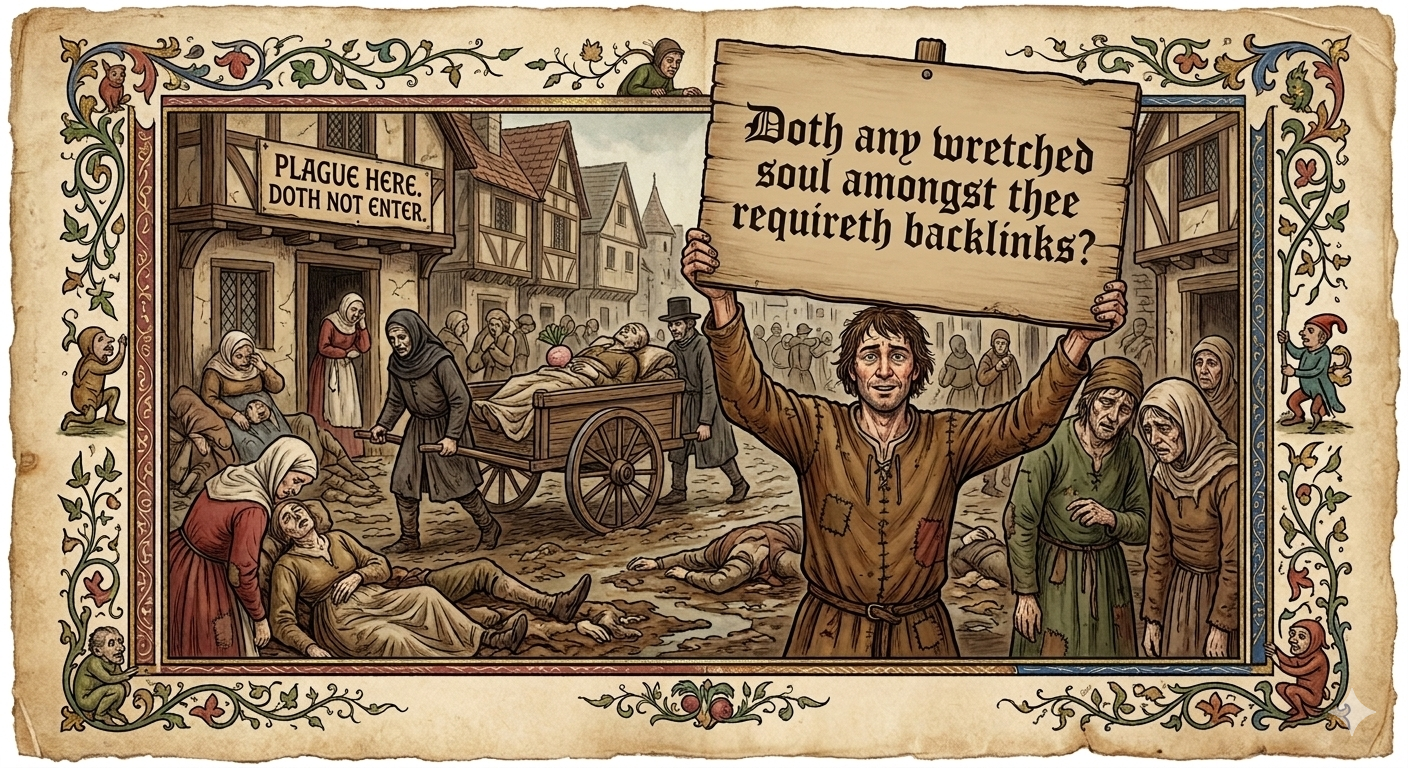
"Doth any wretched soul amongst thee requireth backlinks?" — A serf, doing his best, circa 1347.
In the feudal order, thy reputation was only as substantial as the lords willing to speak thy name at court. A letter of reference from the Archbishop of Canterbury carried considerably more weight than a note from thy cousin Geoffrey, who once briefly owned a goat and hath not stopped mentioning it since. Backlinks function identically: a single link from a domain of great authority is worth ten thousand links from geoffreys-seo-thoughts-definitely-not-spam.blogspot.com.
Thou art a peasant. Thou canst not purchase links — this violateth Google's Webmaster Guidelines, also known as the King's Law, also known as an extraordinarily swift path to manual deindexing and a strongly worded message in thy Search Console. What thou canst do is create content so genuinely useful, entertainingly deranged, or so peculiarly specific that other people doth link to it out of admiration, bewilderment, or an overwhelming desire to show their colleagues what they discovered at eleven of the clock on a Tuesday. All three motivations doth produce valid backlinks.
The Peasant's Link Acquisition Stratagem
- Reddit (The Digital Town Square): Post thy content in a relevant subreddit with a title that doth not reek of "pray, look upon my website." The difference between r/SEO embracing thy post and flagging it as spam is, with some irony, entirely dependent upon whether thy content is genuinely good. The mob hath a nose for desperation.
- Free Press Releases — PRLog, OpenPR: A press release is a town crier dispatched to a hundred villages at once. It costeth nothing, it createth an indexed mention of thy URL upon a domain of some standing, and it maketh thee feel — however briefly — as though thou dost possess an entire communications department. This is a pleasant feeling for a peasant and shouldst not be underestimated.
- YouTube: Google doth own YouTube. Pairing a moving picture with thine article sendeth a signal to the algorithm that thou art serious and multi-format in thy ambitions. A ten-second animation generated by artificial means doth count. A recording of thee reading this very article aloud in an affected medieval accent doth count, and is furthermore funnier than most things currently on the internet.
- Create several pieces and link them hither and thither: Five articles upon the same subject, all pointing toward one another like conspiring monks, doth create a topical cluster. A topical cluster telleth Google thou art an authority. Thou art, at bare minimum, the foremost expert in all the world upon the subject of medieval peasant SEO — for no other soul hath seen fit to write about it. Wield this monopoly wisely.
VI. Indexing — Ensuring Google Doth Actually Find Thee
Publishing thy page and waiting passively for Google to discover it of its own accord is akin to constructing a shop and hoping the King's inspectors happen to wander past in the general direction of thy village. They might! In three to six weeks! Or they might not, and thou shalt sit in thy empty shop consuming turnips and quietly reconsidering thy entire career in content marketing.
Instead, do thus: submit thy URL to Google Search Console forthwith. Navigate to the URL Inspection tool. Paste thy URL. Click "Request Indexing." Google shall in most cases dispatch its crawler within hours. This is thine official deed of land registration — thou art declaring unto the King: this land existeth, it is mine by right of publication, and I wouldst be most grateful for a herald to confirm the matter. The King, in this particular metaphor, is a surprisingly responsive bureaucrat.
Post thy page upon at least one external platform immediately after publishing — not necessarily to attract traffic, though that wouldst be pleasant, but because an external link doth give Googlebot a thread to follow when it next crawleth the web. Thou art leaving a trail of breadcrumbs. Unlike the tale of Hansel and Gretel, this stratagem doth not end with anyone being consumed by a witch. Mostly.
A final word on the matter of 301 redirects — the medieval equivalent of posting a notice upon thy old hovel door declaring: "The serf hath moved. Permanently. Please update thy records accordingly." Should thou ever change thy URL — migrate thy domain, restructure thy site, or simply decide that thy original URL was an embarrassment unto God and man — thou must implement a 301 redirect from the old address to the new one. A 301 redirect doth tell Google "this page hath moved permanently," and transfereth most of thy hard-won SEO equity to the new location. Fail to do so, and every backlink, every crawl signal, every crumb of authority thou hast accumulated shall vanish as completely as a peasant who hath looked at the tax collector for slightly too long. Redirect every single URL. Not just the ones thou dost remember. Every. Single. One.
VII. The Pre-Publication Checklist (Complete Before the Plague Arriveth)
- Primary keyword doth appear in: Title tag, H1, first paragraph, at least two subheadings, and the meta description
- Meta description hath been written (150–160 characters), is enticing, and doth not read like a ransom note slid under a monastery door
- URL is clean, brief, and containeth the keyword:
/medieval-peasant-seo-guide— not/p?id=4892&chaos=yes&god=help - Page doth pass Core Web Vitals (test at pagespeed.web.dev before deploying, lest thou deploy in shame)
- At least one image with descriptive alt text hath been included
- Schema.org Article markup is present within the HTML (it helpeth Google understand what manner of document this is)
- URL hath been submitted to Google Search Console immediately upon deployment
- Page hath been posted upon at least one external platform for the initial crawl signal
- Content doth contain at least eight hundred words of genuine substance, and is not merely a keyword wearing a content costume and hoping no one lookeths too closely
- Thou hast not perished of plague before clicking Deploy. (Shouldst thou have perished: respawn, and deploy anyway)
VIII. Go Forth and Rank, Thou Audacious Serf
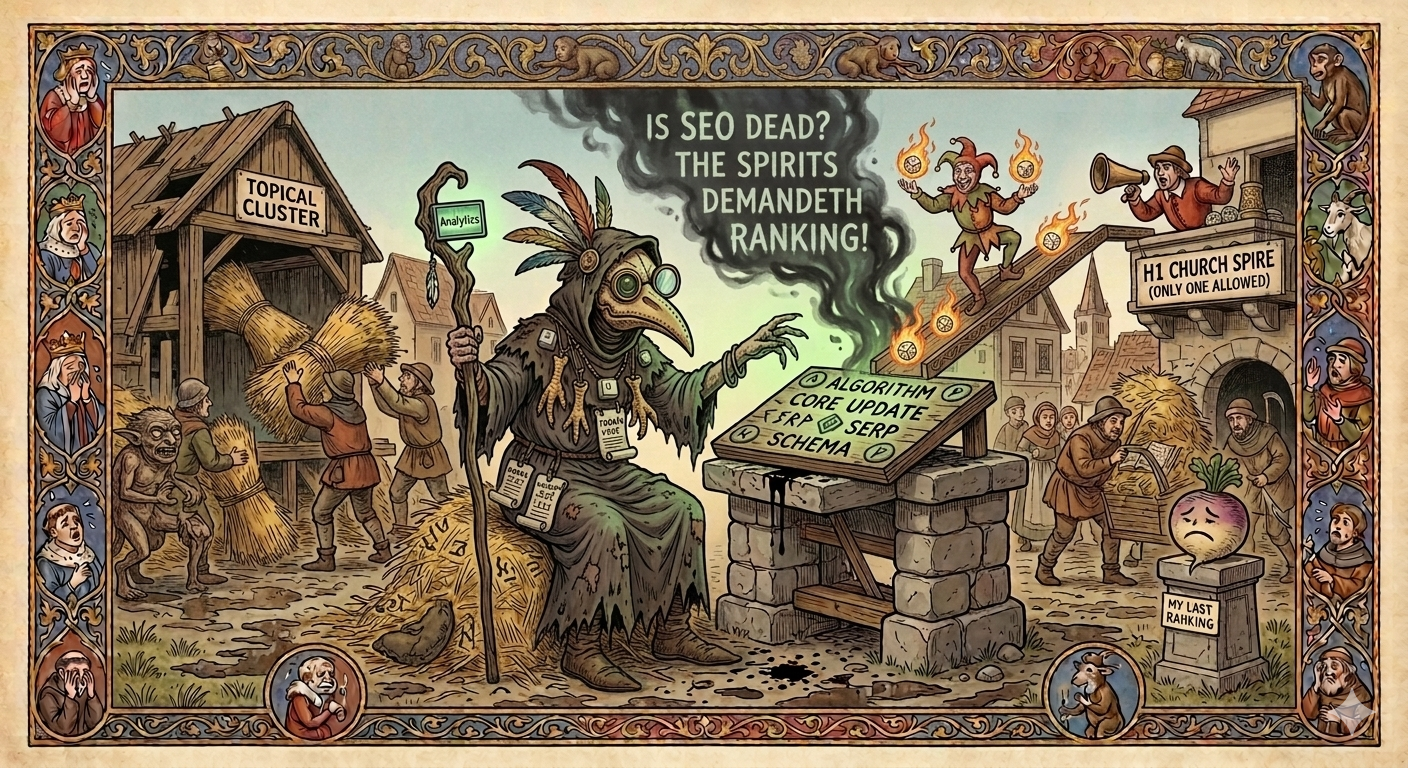
"Is SEO dead? The spirits demandeth ranking!" — A plague doctor consulteth his analytics dashboard, 1347.
The medieval peasant bore every structural disadvantage known to man. No coin. No authority. No domain rating. No understanding of JavaScript — and in this particular regard, things were frankly better for everyone involved. And yet the foundational principle of the medieval peasant SEO guide — find what people dost seek, answer it more thoroughly than any other soul, and ensure the machine can find and comprehend thy answer — is entirely accessible to one who spendeth their days covered in mud, in philosophical negotiation with goats.
Thou dost not require a team of thirty scribes. Thou dost not require a budget. Thou dost not require an expired domain procured from a Latvian merchant at three of the clock in the morning, though we are not here to pass judgement upon that particular stratagem. What thou requirest is: one keyword no other soul hath yet claimed, one piece of content that is genuinely good — or genuinely funny, which sitteth adjacent to good and is often more shareable — one free hosting platform possessed of excellent Core Web Vitals, and the patience to wait a fortnight whilst Google deliberateth upon whether thou dost in fact exist.
The algorithm is indifferent to prestige. It knoweth not that thou art a peasant. It knoweth only whether thy page answereth the query, loadeth with haste, and earneth clicks. These are, historically speaking, the most democratic ranking factors ever devised by mortal hands. The top fifty is not a castle. It is an unlocked door. Walk thou through it.
IX. Frequently Asked Questions of the Realm
The following queries were submitted via carrier pigeon and hath been answered herein to the best of this humble serf's abilities.